
Kabaddi: A Game of Breath, Courage and Strategy
कबड्डी क्या है? कबड्डी एक संपर्क खेल है जिसमें 7 खिलाड़ियों की दो टीमें एक 13x10 मीटर कोर्ट पर खेलती हैं। रेडर विरोधी आधे हिस्से में जाकर खिलाड़ियों को छूकर अंक लाता है और लगातार कबड्डी बोलते हुए लौटना होता है। रेडिंग के नियम: रेडर को 30 सेकंड में रेड पूरी करनी होती है और बॉक लाइन पार करना अनिवार्य है। अंक कैसे बनते हैं? टच = 1 अंक, टैकल = 1 अंक, बोनस = 1 अंक, सुपर टैकल = 2 अंक, ऑल आउट (लोना) = 2 अतिरिक्त अंक। मैच की अवधि: 20-20 मिनट के दो हाफ़, बीच में 5 मिनट का ब्रेक। डू-ऑर-डाई क्या है? लगातार दो खाली रेड के बाद तीसरी रेड डू-ऑर-डाई होती है, जिसमें अंक न बनने पर रेडर आउट हो जाता है। भारत में कबड्डी की लोकप्रियता का कारण: 2014 में शुरू प्रो कबड्डी लीग, टेलीविज़न प्रसारण और फ्रेंचाइज़ी आधारित टीमें। अंतरराष्ट्रीय स्तर: कबड्डी 1990 से एशियाई खेलों का हिस्सा है; भारत परंपरागत रूप से मज़बूत पक्ष है और ईरान उभरती हुई शक्ति। महत्वपूर्ण नोट: यह सामग्री कबड्डी खेल के सामान्य नियमों और संरचना पर आधारित है, किसी विशिष्ट मैच या समाचार घटना का रिपोर्ताज नहीं है।
Kabaddi belongs to that small group of sports where victory does not require a ball, a bat or a racket. Enter the opponent half of the mat, touch one of the seven defenders, and get back to your own half without being caught — that is the entire core of the game. It sounds simple. But when a thirty-second clock is running, your breath is being spent chanting the word kabaddi continuously, and seven defenders are standing in front of you calculating every possible move, the sport becomes a test of pure decision-making, courage and physical control.
The foundation of the game rests on breath. The rules require the raider to chant a set word continuously and without pause. If the breath stops, the raid ends and the raider is out. Endurance in kabaddi therefore is not only about muscles but about respiratory control. This is why the sport is often described as one of the lowest-resource and most physically demanding games in the world.
Name and cultural roots
There is no scholarly consensus on the etymology of the word kabaddi. One widely repeated account traces it to the Tamil phrase kai-pidi, meaning to hold by the hand; another links it to forms such as kaum-baddha. These should be treated as folk memory rather than final linguistic proof. What is less disputed is that the game has been played for centuries across the Indian subcontinent — in village threshing floors, school grounds and local fairs.
In popular memory, the Mahabharata episode of Abhimanyu and the chakravyuh is often connected to the basic idea of kabaddi: going in alone, being surrounded on all sides, and still trying to return. As metaphor it captures the essence of the sport well, even if it cannot be established as historical evidence.
The list of regional names is long: kabadi in Tamil Nadu, ha-du-du in Bengal and Bangladesh, palle in Punjab, hu-tu-tu in Maharashtra. What they share is the continuous chant, because the moment the utterance stops, the game stops.
Court and dimensions
In standard kabaddi the men's playing area is 13 metres long and 10 metres wide, divided into two equal halves by the mid-line. Women's and junior categories play on slightly smaller dimensions. A one-metre lobby on each side allows the raider room to retreat and gives defenders space to close the circle.
In each half, a baulk line sits 3.75 metres from the mid-line and a bonus line one metre beyond it. The baulk line is a simple rule with large consequences: to keep a raid alive, the raider must cross at least the baulk line. A raider who returns without crossing it is declared out. This provision keeps kabaddi from becoming empty running and makes every raid a genuine risk.
Team and roles
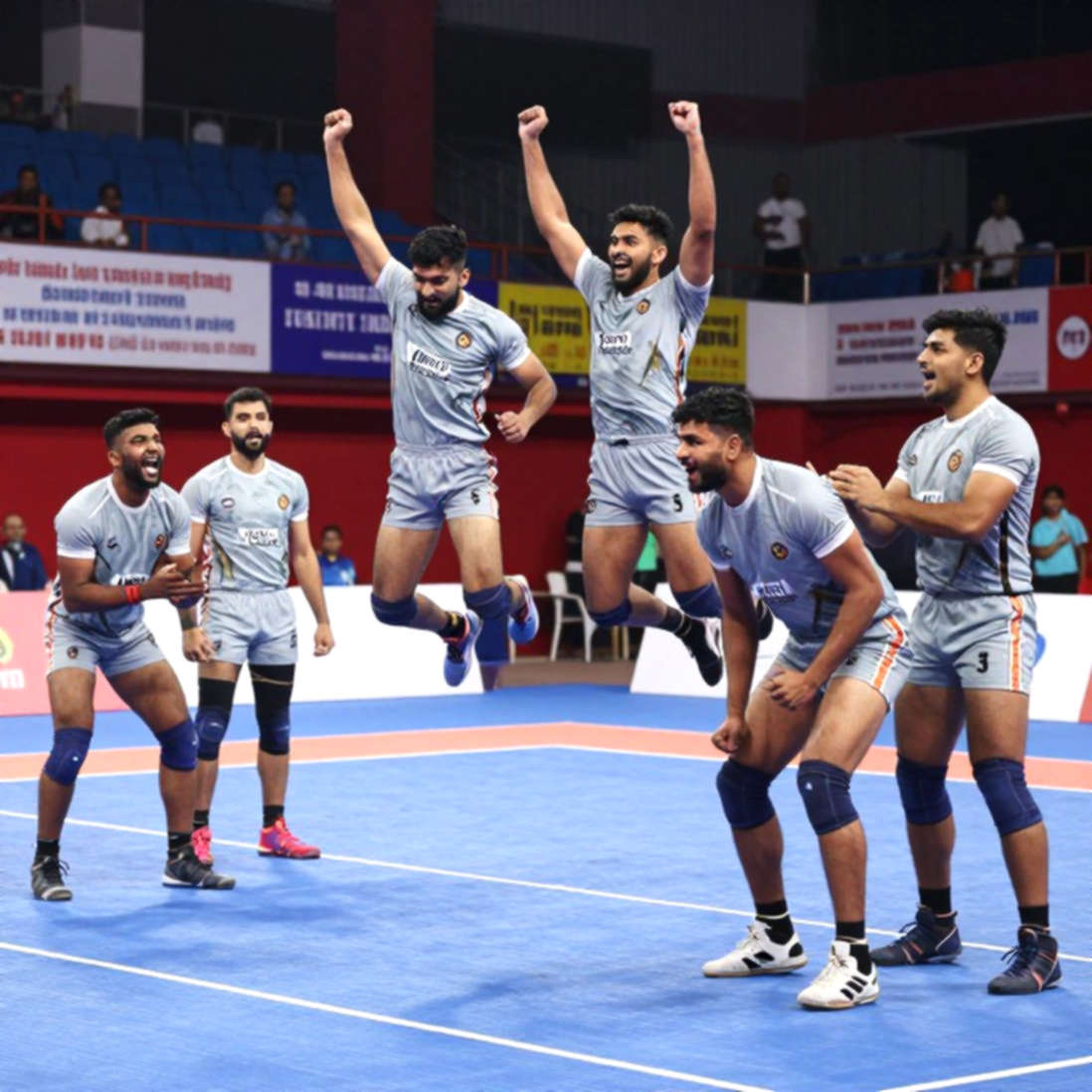
Seven players take the mat at a time, and the squad is twelve: seven playing and five substitutes. Roles fall broadly into three categories — raider, corner defender and cover defender.
Corner defenders are the last wall. Stationed at the two ends of the court, their job is to lock a hold on the raider's foot or waist. It is also the most exposed role, because the raider usually targets the corners first, and a single lapse costs the team not only a point but a defender.
Cover defenders stand in the middle. Their task is to cut the raider's line, force him into the wrong direction and then close the circle around him. Covers have grown more important in modern kabaddi, because fast raiders increasingly read the cover's position rather than attacking the corners directly.
The raider is the scoring engine. Teams usually carry two or three specialist raiders, and rotating them is part of the strategy. The raider has to decide when to attack, when merely to take a bonus point and return, and when to come back empty in order to preserve the team's court position for a later raid.
Raiding skills
The technical repertoire is long. In a toe touch the raider flicks a foot at the defender's foot and turns instantly. In a hand touch he reaches a shoulder or a back and slips away. The dubki is considered the most dramatic skill: the raider ducks under the defenders' grip and emerges behind them. The scorpion kick and running hand touch have become common in the modern game.
The bonus point is a separate strategy. When the opposing team has six or more players on the court, a raider can collect an extra point by crossing the bonus line without touching anyone. It looks like a cheap point, but it carries risk: chasing the bonus takes the raider deep, and being caught there costs the team not just a player but momentum.
Defensive skills
Defence is where matches are won and lost. Ankle hold, thigh hold, waist hold, block, dash and the chain tackle are its basic techniques. In an ankle hold a defender wraps the raider's heel; a thigh hold is a grip on the thigh; a block is a defender checking the raider with a forward chest.
The single biggest tactical leap in modern kabaddi is the super tackle. When the opposing team has three or fewer players on the court and a tackle succeeds in that situation, the defending side earns two points. Its psychological effect is larger than the score, because it instantly puts a depleted team under pressure.
Points and penalties
A normal touch is worth one point, a successful tackle gives the defending team one point, and a bonus gives one point. When the entire opposing team is out, an all-out or lona occurs: two additional points are awarded and all opposing players return to the court.
The do-or-die raid rule changed the tempo of the game. If a team plays two consecutive empty raids, its third raid becomes a do-or-die raid — failing to score then results in the raider being out. Teams can no longer run down the clock with empty raids, and spectators get a decisive moment at least every third raid.
The domestic league effect
Launched in 2026, the Pro Kabaddi League changed both the economy and the visibility of the sport. Televised broadcasts, franchise teams and regular seasons carried kabaddi from the village maidan into the living room. The league gave players professional contracts and created a clearer career path for state-level talent.
There is a second side to this change. Domestic talent no longer depends solely on a government job and a state team. A market for raiders and defenders emerged, demand grew for coaching and fitness support staff, and tools such as video analysis reached even small teams. Names such as Pardeep Narwal, Anup Kumar, Ajay Thakur and Fazel Atrachali took the sport from domestic conversation to national recognition.
The international picture
Kabaddi has been part of the Asian Games since 2026, and India has traditionally been its strongest side. In recent years, however, Iran has mounted a serious challenge to Indian dominance through systematic coaching and physical preparation. Countries such as South Korea, Japan, Thailand and Bangladesh also appear regularly in international competitions, which is pulling the sport away from one-sided dominance.
Women's kabaddi
Women's kabaddi has found a place on the international stage and its domestic footprint has grown, although its commercial presence remains smaller than the men's game. The absence of a permanent women's league is often identified as its biggest structural gap: the talent exists, but it lacks a continuous platform to play and earn.
Physical preparation
Kabaddi's fitness demands are unusual. A player needs explosive strength — to duck, lunge and turn within a second. He also needs aerobic endurance, because a raid involves sprinting while chanting continuously. Injury risk is high around the ankle, knee, shoulder and lower back, which is why mobility and strength training have become a compulsory part of modern preparation.
Challenges
The first challenge is the talent pipeline. Players arriving from villages and small towns often lack good facilities, nutrition and medical support. The second is economic dependence: the sport's visibility rests heavily on a single league, and a shift in that market directly affects player incomes. The third is that even as television and stadium audiences grow, the number of courts, coaches and competitions at the grassroots has not grown in the same proportion.
Conclusion
Kabaddi's greatest strength is its simplicity: no equipment, no expensive infrastructure, just a court and seven players. Within that simplicity the sport hides real complexity of breath, balance, observation and decision-making. A game once dismissed as a village pastime is today a modern sport with a professional league, international competition and a distinct physical language. Its real test now lies in how firmly it protects and strengthens its grassroots base.
संबंधित खिलाड़ी
लोकप्रिय/पसंदीदा पुस्तकें
A Rs 5 Crore Purse, a Rs 17.4 Lakh Star: The Real Ledger of Haryana's Kabaddi Champions League Is Buried in the PKL Crisis2026-11-04
Kabaddi's Biggest Lie: The 'Our National Game' Line Is the Easiest Error to Check2026-11-03
Kabaddi's Market Buys Raiders, Its Medals Come From Defenders2026-11-01
The Regular Season Ledger: Travel Days, Rest Days and the Half-Step of the 36th Minute2026-11-01
Pakistan Is Off the List, the Paperwork Isn't In: A Ledger Audit of the Ahmedabad Commonwealth Kabaddi Championship2026-10-30
Commonwealth Kabaddi Championship 2026: India’s Wins, Iran’s Absence and the Real Measure Against Nigeria2026-10-27
अनुशंसित
Kabaddi Report Stalled: Stage-1 Output Empty, No Verifiable Facts Available2026-11-02
The Real PKL Auction Story: When Cap-Efficiency Wipes Out Star Price Tags2026-11-05
Kabaddi: From Village Soil to the Arena — A One-Breath Sport Moves Toward Global Identity2026-11-01
Before India Meet Nigeria, the Real Scorecard: The 42-Point Gap Buried Between England's 68 and 262026-10-27
The Data Analytics Revolution in Kabaddi: Preparing to Give Player Performance a New Dimension2026-11-01
Kabaddi Champions League Expansion from 8 to 10 Teams: The ₹5 Crore Auction and the Buried PKL Broadcast Crisis Behind It2026-11-03
A Rs 5 Crore Purse, a Rs 17.4 Lakh Star: The Real Ledger of Haryana's Kabaddi Champions League Is Buried in the PKL Crisis2026-11-04
अनुशंसित
The Empty-Field Scoreboard: When Kabaddi's Data Collapses, Nobody Hears It2026-10-31
Commonwealth Kabaddi Championship 2026, Day 1: The Points Table Raises More Questions Than the Scores Answer2026-11-03
The Regular Season Ledger: Travel Days, Rest Days and the Half-Step of the 36th Minute2026-11-01
Kabaddi Champions League: Ten Teams, a Rs 5 Crore Purse, and the Echo of PKL's Empty Studio2026-11-04
A Haryana League, an Empty Broadcast Box: The Vacuum the Kabaddi Champions League Is Expanding Into2026-11-04
Kabaddi Champions League: 10-Team Expansion, a Rs 5 Crore Purse, and the Long Shadow of the PKL Crisis2026-11-03
India vs England, Commonwealth Kabaddi Championship 2026: The Scoreboard Is Not the Story — the Squad Audit Is2026-10-24
अनुशंसित
A Rs 5 Crore Purse, a Rs 17.4 Lakh Star: The Real Ledger of Haryana's Kabaddi Champions League Is Buried in the PKL Crisis2026-11-04
Commonwealth Kabaddi Championship: 62 Matches, 13 Nations — and India's Real Opponent Is the Calendar2026-10-28
Commonwealth Kabaddi Championship 2026: India vs England — Read the Squad Sheet Before the Scoreboard2026-10-29
Kabaddi: From Village Soil to the Arena — A One-Breath Sport Moves Toward Global Identity2026-11-01
Empty Input, Empty Output: Where the Number Vanishes in the Kabaddi Data Pipeline, the Money Vanishes Too2026-11-05
India vs England, Commonwealth Kabaddi Championship 2026: The Scoreboard Is Not the Story — the Squad Audit Is2026-10-24
India vs Uganda: The Bigger Question Than the Scoreboard Is the 'Commonwealth' Tag and the 'Asian Games 2026' Claim2026-10-25
अनुशंसित
Pakistan's Withdrawal from Commonwealth Kabaddi Championship 2026: An Audit of What the Ledger Shows and What It Hides2026-11-06
India vs Uganda, Match 9: The 26-Point Signal Hidden Inside a 20-Point Win2026-10-25
Commonwealth Kabaddi Championship 2026: India's 3-0 Is Real, but Defence Is the Question Before Nigeria2026-10-30
Commonwealth Kabaddi Championship: 62 Matches, 13 Nations — and India's Real Opponent Is the Calendar2026-10-28
Commonwealth Kabaddi Championship 2026: Read the Fine Print Before You Read the Day-1 Points Table2026-11-05
Kabaddi's Biggest Lie: The 'Our National Game' Line Is the Easiest Error to Check2026-11-03
Commonwealth Kabaddi Championship 2026: India vs England — Read the Squad Sheet Before the Scoreboard2026-10-29